
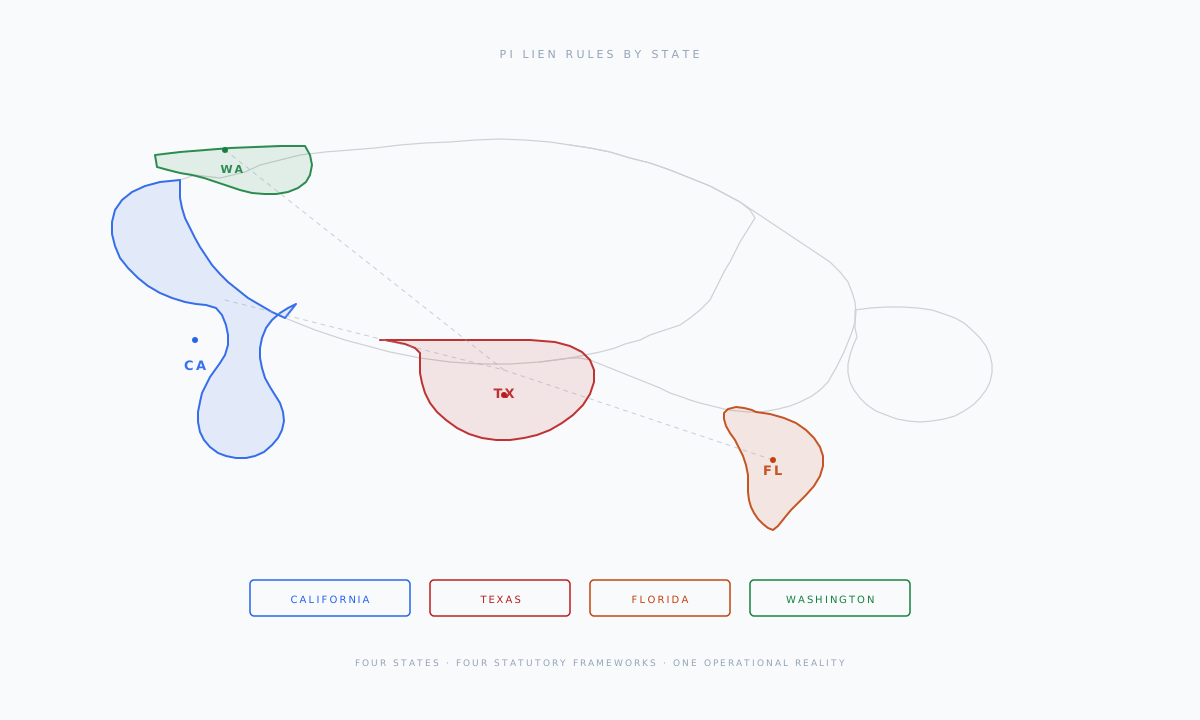
PI lien practice is a state-law puzzle. The instrument you operate under, the window you have to perfect it, your priority at the closing table, and how long the underlying tort claim stays alive — all of those vary meaningfully by state. The four states below cover the majority of US personal injury litigation volume, and the rules are different enough in each that a clinic operating in multiple states cannot reuse the same playbook.
This guide is operational, not academic. We cite the statutes by section so you can read them yourself or hand them to counsel. If you want the broader lifecycle context first, the PI medical lien playbook is the place to start.
The four-state landscape, at a glance
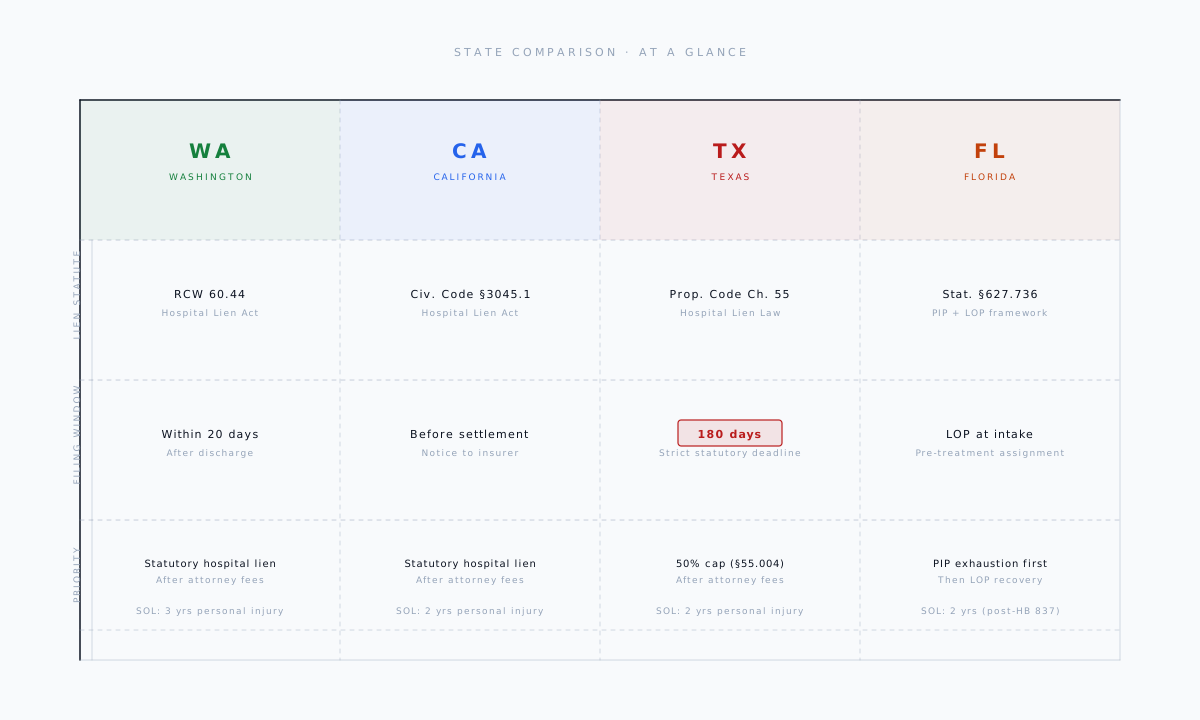
Three patterns stand out. First, statutory liens favor hospitals; non-hospital providers (chiropractors, physical therapists, imaging centers, pain management, orthopedics) operate primarily under Letters of Protection in three of the four states. Second, filing windows are non-uniform — Texas's 180-day window is unforgiving; California's framework is more permissive but has its own perfection requirements. Third, statutes of limitations are tightening — Florida's recent HB 837 reform cut the negligence SOL from 4 years to 2 years, narrowing the case window meaningfully.
The next four sections take each state in turn. Each section has its primary statute citation linked to the official text and a practical takeaway for clinic operators.
California
The largest PI litigation market in the US. Statutory hospital liens; LOP-driven for everyone else.
The Hospital Lien Act
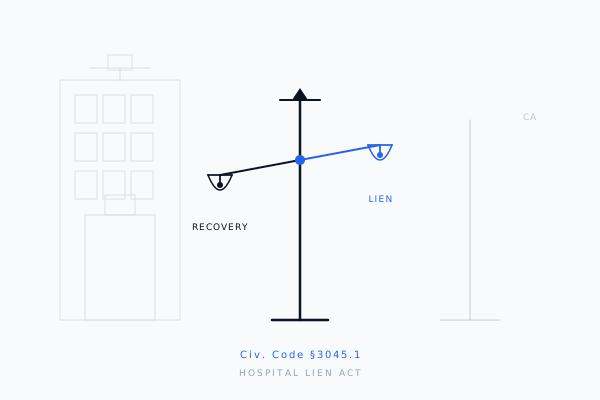
California's Hospital Lien Act (Cal. Civ. Code §§3045.1–3045.6) creates an automatic lien on personal injury settlement proceeds for the reasonable and necessary charges of hospitals, ambulance services, and certain emergency providers. The lien attaches to any sum due the patient from a third-party tortfeasor, and the hospital must give notice to the tortfeasor (and to their insurer) for the lien to be enforceable.
The key operational point: the statute covers hospitals and named adjuncts. It does not cover most clinic-side providers — chiropractors, PTs, imaging centers operating outside a hospital, pain management clinics. Those providers operate on Letters of Protection.
What non-hospital providers actually do
The standard practice in California for non-hospital PI work is the LOP, signed by both the patient and the patient's attorney. The LOP is enforceable as a contract; it puts the attorney on notice that settlement proceeds must be held back to pay the provider before disbursing the balance to the patient. California attorneys overwhelmingly honor properly executed LOPs — the bar is professional discipline if they don't.
MICRA and the 2023 cap update
California's Medical Injury Compensation Reform Act (MICRA) caps non-economic damages in medical malpractice cases. The 2023 update raised the cap (and indexed it to inflation), which affects what the patient's case may be worth — and therefore what the lien gets paid out of. Not directly a lien-practice issue, but worth understanding because it shows up in the negotiation math.
Statute of limitations
California's general personal injury SOL is two years (Cal. Code Civ. Proc. §335.1), running from the date of injury — with discovery-rule wrinkles for injuries that aren't immediately apparent.
Practical takeaway for California clinics
If you're a hospital, perfect your statutory lien — notice, properly, every time. If you're a chiro, PT, imaging, or pain-management clinic, your operational instrument is the LOP. Track the SOL on every case from day one; California's discovery-rule exceptions are narrow and the 2-year clock runs fast.
Texas
Hospital liens with a strict 180-day filing window. Massive PI volume in Houston, Dallas, San Antonio.
The Texas Hospital Lien Act
Texas Property Code Chapter 55 creates a hospital lien for services provided to a person injured by a third party. The lien covers the hospital's first 100 days of services and attaches to the patient's cause of action against the third party.
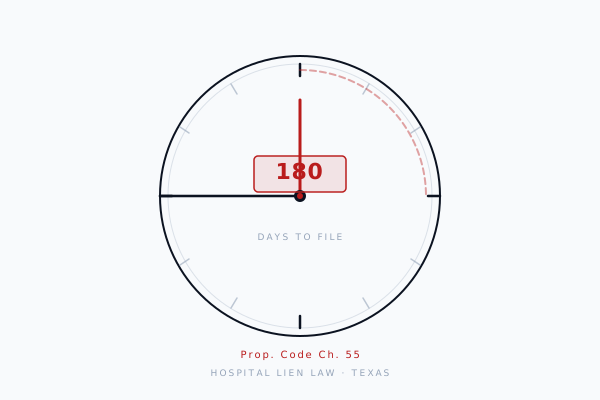
The most operationally important detail in Chapter 55 is the filing window: the lien must be filed with the county clerk's office in the county where the services were provided, before the date of any settlement or no later than 180 days after the patient's discharge. Miss the window and the statutory lien is gone; what's left is a contractual claim that may or may not survive negotiation.
Priority and the attorney fee carve-out
Texas's statutory framework gives the hospital lien a defined position in the disbursement order, after the attorney's reasonable contingency fee and case expenses. The hospital lien is also capped — Property Code §55.004 limits the recoverable amount to 50% of the settlement net of attorney fees and case costs (the cap is computed against the post-fee figure, not the gross). In practical terms: subtract attorney fees and expenses first, then the hospital lien recovers at most half of what remains. The carve-out is the law; it is not negotiated case by case.
What non-hospital providers do
As in California, the Chapter 55 lien covers hospitals (and emergency services in defined circumstances). Chiropractors, PTs, imaging centers, and other non-hospital clinics operate on LOPs. The LOP framework in Texas is well-established and routinely honored by plaintiff firms, but it is contractual — perfect your documents.
Statute of limitations
Texas's PI SOL is two years (Tex. Civ. Prac. & Rem. Code §16.003). The clock starts from the date of injury.
Practical takeaway for Texas clinics
If you're a hospital, the 180-day filing window is the single most important date in your PI workflow. Build it into your intake — every accident-related admission should produce a lien filing within 90 days, with the second 90 as buffer. If you're a non-hospital provider, the LOP is your instrument; document it cleanly, track it across the (typically long) Texas PI case timeline, and remember that the 50% cap on statutory liens means the LOP universe in Texas is meaningfully larger than the statutory-lien universe.
Florida
No-fault PIP state. LOP is the dominant instrument. Post-HB 837 the legal landscape changed materially in 2023.
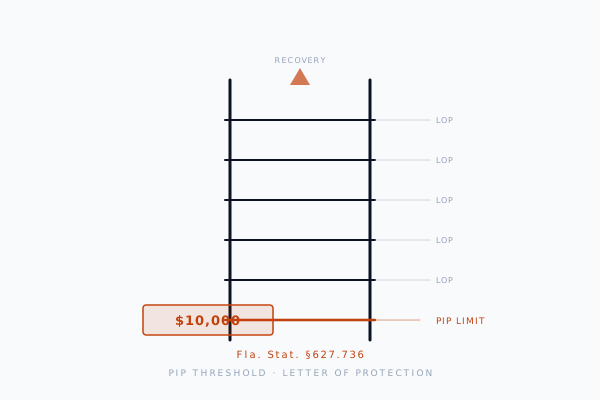
Why Florida is different — PIP and the $10K no-fault threshold
Florida is a no-fault state. The Florida Motor Vehicle No-Fault Law (Fla. Stat. §627.736) requires every Florida driver to carry Personal Injury Protection (PIP) coverage with at least $10,000 in benefits, which pays the first $10,000 of medical expenses regardless of fault. PIP applies before any third-party liability coverage; the BI / UM stack only kicks in once PIP is exhausted and the patient's injuries meet the statutory "permanent injury" threshold.
For clinics, this means the first $10K of treatment is typically billed against PIP. PIP has its own procedural quirks — including a 60-day window for the insurer to pay or deny claims, and the requirement that the patient seek initial services within 14 days of the accident for full PIP coverage. These are operational, not strategic, but missing them costs real money.
Letter of Protection as the dominant instrument
Beyond PIP, Florida PI practice runs on LOPs. There is no broadly applicable hospital-lien analog to California or Texas in the Florida context, so even hospitals frequently operate on LOPs for the portion of bills above PIP. The LOP framework is enforceable as contract; Florida courts have a developed body of case law around LOP validity, attorney duty to honor, and reasonable-value disputes.
The 2023 tort-reform changes (HB 837)
Florida's HB 837, signed in 2023, reshaped the LOP and damages landscape. Key changes for clinics:
- Negligence SOL cut from 4 years to 2 years.
- Increased disclosure requirements around LOPs and the financial relationships between providers and referring attorneys.
- Tightened standards on what evidence of medical expenses is admissible at trial (the "letter of protection" framework now interacts with the new admissibility rules in ways that affect how bills are presented).
The practical effect: documentation matters more than it did pre-2023, and the case window is tighter. Clinics that adopted post-HB 837 documentation discipline (specific narratives, contemporaneous records, careful billing) have done better in the post-reform environment than those that did not.
Statute of limitations
Two years on negligence, post-HB 837 (Fla. Stat. §95.11(4)(a)), running from the date of injury. Pre-HB 837 cases (injuries before March 24, 2023) are grandfathered into the prior 4-year SOL.
Practical takeaway for Florida clinics
PIP first, LOP second — that's the operational order. Track the 14-day initial-services window for PIP cases. Adapt your documentation discipline to HB 837's tighter admissibility standards. Track the 2-year SOL from day one on every post-HB 837 case; the clock is shorter than it used to be and the case window is no longer forgiving.
Washington
Hospital lien under RCW 60.44; LOP-driven for non-hospital providers. Three-year SOL is the longest of the four.
The Washington hospital lien
RCW 60.44 creates a lien for the reasonable value of services rendered by a hospital or operator of an ambulance for the care of a person injured by the act or negligence of another. The lien attaches to any judgment, award, or settlement the patient receives from the third party.
The lien must be filed in the county where the services were rendered, within 20 days after the patient is discharged. Notice must also be given to the patient, the third party, and the third party's insurer.
The 20-day filing window is shorter than Texas's 180-day window and is the operational risk that Washington hospital billing teams have to manage. Miss it and the statutory lien is unenforceable; what's left is contractual.
Non-hospital provider practice
As in CA and TX, the RCW 60.44 statutory lien is narrower than the universe of clinic-side PI work. Chiropractors, PTs, imaging centers, and pain management clinics in Washington operate on Letters of Protection. The LOP framework is well-developed in Washington case law and routinely honored by plaintiff firms.
One Washington-specific wrinkle worth knowing: the interaction between the lien and the patient's health insurance subrogation rights. Washington's made-whole doctrine limits subrogation in some scenarios — meaning that when an injured patient has both a treatment lien and a health-insurance-paid claim, the disbursement math can get complex. This is a place to involve counsel rather than guess.
Statute of limitations
Washington's PI SOL is three years (RCW 4.16.080), the longest of the four states in this guide. The longer SOL means cases have more time to develop and settle, but also more time for clinical context and operator knowledge to decay if not captured.
Practical takeaway for Washington clinics
If you're a hospital, the 20-day filing window is the highest-priority date in your PI workflow — automate the reminder out of the EHR or PMS as a hard alert. If you're a non-hospital provider, the LOP is your instrument; the 3-year SOL gives you more runway but does not absolve you from tracking each case from day one. The made-whole doctrine interaction is the place to have counsel reviewing your specific lien-vs.-subrogation conflicts.
Cross-state operational implications for clinics
A clinic operating in only one of these four states has one playbook. A clinic operating in multiple — increasingly common as PI-focused practices expand — has four. The operational implications:
- Intake forms differ. California and Washington intake can be more forgiving on the lien-vs-LOP distinction; Texas intake should produce a lien filing decision within the first week to protect the 180-day window; Florida intake has to capture PIP eligibility and the 14-day initial-services window.
- Cadence differs. Washington's 3-year SOL means cases can sit longer without becoming time-pressured; Texas's 2-year SOL plus the 180-day filing window means urgency is front-loaded.
- Documentation standards differ. Florida post-HB 837 has the most explicit documentation requirements; the other three states have lower statutory floors but the same practical reality (better records produce better settlement offers).
- Negotiation posture differs. Texas's 50% statutory cap on hospital liens means there's less room to negotiate on statutory liens than there is on LOPs; California's MICRA cap shapes the upper bound on malpractice damages; Florida's tightened admissibility rules affect what evidence the attorney can put in front of a jury, which affects what the carrier offers.
A clinic that treats all four states as interchangeable will leave money on the table in at least one of them — usually in the state where the requirements are tightest (Texas's filing window, Florida's HB 837 documentation) and the operator has not internalized the local rule.
How Voxenti handles state-specific PI work
Voxenti is built for the operational reality above. The activity log on each case captures the lien instrument (statutory lien vs. LOP vs. assignment), the state, and the relevant filing dates. Follow-up cadences can be tuned per state — Texas's 180-day clock surfaces differently in the queue than Washington's 3-year SOL. The attorney correspondence history persists across cases regardless of which state's framework a particular case operated under, so the operator handling a multi-state practice can see "we've worked 14 cases with this Florida firm; here's how they typically negotiate post-HB 837" without rebuilding context.
The honest scope, again: Voxenti is a software platform. It runs the operational layer. It does not provide legal advice, and the statute citations in this guide are starting points for your own research and conversations with counsel — not substitutes for them.
What to read next
- The PI Medical Lien Playbook — the lifecycle context for everything above.
- Healthcare Has Systems of Record. It Lacks Systems of Recovery. — why the workflow surrounding a lien, not the balance, is the real problem.
If you operate in any of CA, TX, FL, or WA and want to see how a state-aware workflow runs on a real case from your clinic, book a 30-minute walkthrough.
Book a 30-minute demo